
%20(1).jpg)
School transport has long been treated as a predictable, operational necessity. But across the globe, that assumption is being challenged. Costs are rising at a pace that many schools, districts, and governments are struggling to absorb, turning what was once a stable service into a growing financial pressure point.
At the same time, expectations are shifting. Parents increasingly expect real-time visibility of their child’s journey. Local authorities are under pressure to improve accountability and reporting. Operators are being asked to deliver more complex services with fewer resources.
This combination of rising costs and rising expectations is exposing the limitations of traditional, static transport models.
We’ll cover:
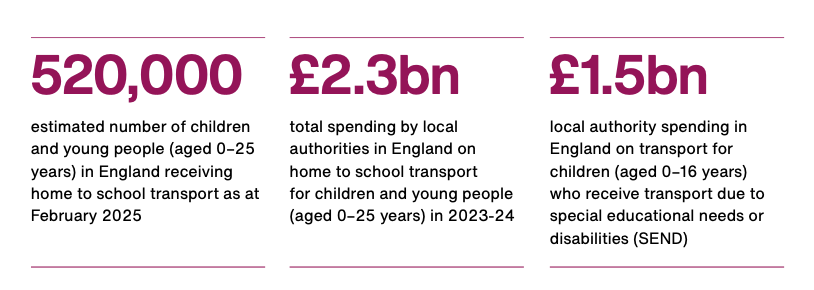
In England, spending on home-to-school transport reached £2.32 billion in 2023–24, representing a 70% real-terms increase since 2015–16.
A global trend that’s accelerating
The data paints a clear picture of increasing costs of school transport rising globally across all major markets, and the scale and pace of that increase is becoming harder to ignore.
Analysis from the National Audit Office highlights just how quickly costs are escalatingData drawn from the Department for Education reinforces this trend, showing that the increase is being driven largely by rising demand - particularly for students with special educational needs and disabilities (SEND). Spending on SEND transport has more than doubled over the same period and now accounts for the majority of total expenditure, placing sustained financial pressure on local authorities.
Across Australia and parts of Europe, the same structural challenges are emerging. Insights from the Local Government Association point to a consistent pattern: constrained labour markets, longer and more complex routes, and rising per-mile operating costs. These pressures are further compounded by increasing demand for specialised transport services for specific transport needs, such as student transportation.
Taken together, these trends point to a system under strain. Costs are rising because the model itself is becoming more expensive to sustain and offering the same service is becoming more expensive.
What’s driving the increase?
How transport services are planned and managed is consistently seen as a key driver to increasing costs.
Many school transport systems still rely on fragmented tools, manual scheduling, and static route design. Passenger data sits across spreadsheets, communication with parents is often indirect, and real-time visibility of services is limited. This creates inefficiencies that are difficult to identify, let alone resolve.
In practical terms, this means:
- Resources are not always allocated in the most efficient way
- Vehicles are underutilised or routes duplicated
- Changes in demand are slow to be reflected in operations
In a high-cost environment, these gaps are no longer sustainable.
The impact beyond transport
The implications of these pressures extend well beyond transport departments.
The National Audit Office UK has warned that rising home-to-school transport costs, particularly for SEND students, are placing significant strain on local authority finances. This is contributing to broader funding challenges across the education system.
For schools and districts globally, the response often involves difficult trade-offs: reducing routes, limiting eligibility, or reallocating funding from other priorities. For families, this can mean higher costs, longer journey times, and reduced access to reliable transport - particularly in rural or underserved communities.
At the same time, expectations around service quality continue to increase. Parents expect visibility of where their child’s vehicle is, clear communication, and the ability to adapt journeys when needed. Meeting these expectations within a constrained cost environment adds further pressure to already stretched systems.
Rethinking the model
What’s becoming clear is that incremental change is no longer enough. The traditional model, built on fixed routes and assumptions about demand, struggles to adapt in a more dynamic and cost-constrained environment.
In response, many transport authorities are beginning to explore more flexible, data-driven approaches. Approaches that require a connected system, bringing together planning, operations, and user experience.
Enabling change through smarter systems
This is where technology-enabled platforms such as those developed by Liftango, demonstrated in projects such as Transporte Escolar Gratuito in Sao Paulo supporting 4,200 school buses across the region, are playing an increasingly important role.
Tools such as these, at their core, are demand matching engines that use algorithmic route optimisation to ensure available resources are scheduled as efficiently as possible. This allows passenger transport teams to dynamically allocate vehicles, drivers, and passenger assistants based on real demand, rather than static assumptions.
Around this, a connected set of tools enables end-to-end visibility and control. Elements can include those such as Liftangos:
- Passenger app that allows parents and students to view real-time vehicle tracking, receive updates, and modify or cancel journeys as needed
- Driver app that supports scheduling, navigation, and real-time communication, improving both efficiency and service reliability
- An operations platform that enables local authorities to manage fleet administration, driver and passenger assistant coordination, incident capture, and call centre bookings in a single environment
- Integrated data and reporting tools that replace fragmented spreadsheets with a consistent, centralised view of performance, utilisation, and service delivery
- A cashless payments module and integration layer that connect with wider transport systems, ticketing platforms, and third-party software, removing the need for students to carry cash and buy daily or weekly tickets that can be mislaid
Together, these capabilities enable school transport organisers to:
- Schedule resources more efficiently
- Track vehicles and passenger interactions in real time and historically
- Improve accountability and transparency in service delivery
- Strengthen reporting and data-driven decision making
This is not just about digitisation but about creating a system that is responsive, connected, and capable of adapting to ongoing change.
A more sustainable path forward
The rising cost of school transport is not a temporary spike. It reflects deeper structural challenges that require a new approach.
With the right combination of data, technology, and partnership, there is an opportunity to move beyond reactive cost management and towards proactive optimisation. Systems can become more efficient, services more responsive, and outcomes more equitable.
For Liftango, this evolution represents an opportunity to support schools, operators, and local authorities in building transport networks that are more cost-effective, more transparent, and aligned with the needs of modern student transportation.
Find out more about how we can help - Contact us today.
